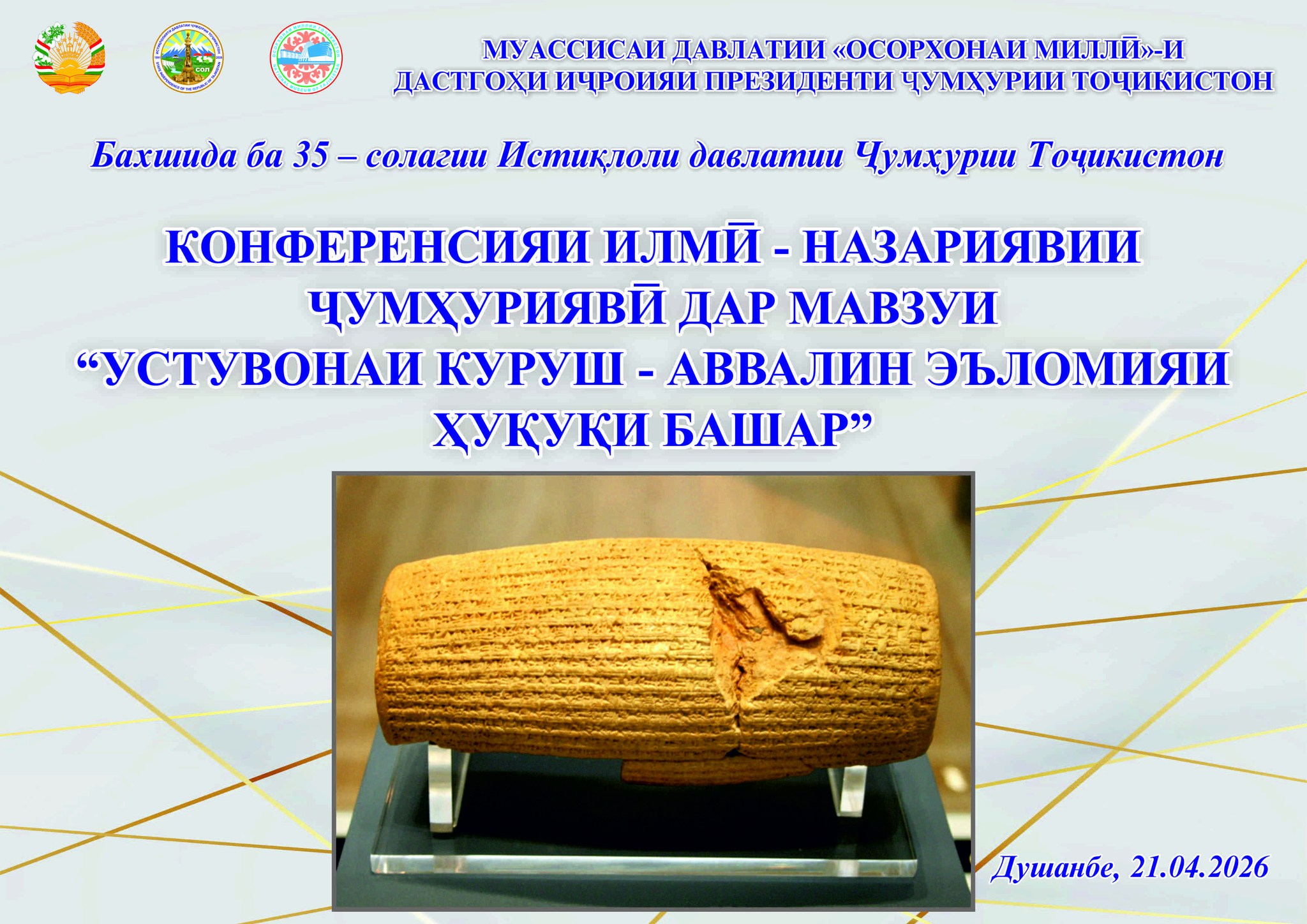
“The Cyrus Manifesto — The First Declaration of Human Rights.” Holding of a national scientific and theoretical conference at the National Museum
On April 21, 2026, at the State Institution “National Museum” of the Executive Office of the President of the Republic of Tajikistan, a national scientific and theoretical conference dedicated to the 35th anniversary of the State Independence was held under the title “The Cyrus Manifesto — the First Declaration of Human Rights,” with the participation of a wide range of scholars, writers, and domestic researchers.
The conference commenced with an opening address by the Director of the National Museum, Ibrohimzoda Zafarsho Safo, who noted that the Manifesto of Cyrus the Great possesses global scientific and historical significance and has been recognized by scholars and political figures as the first declaration of human rights.
During the conference, Academician of the National Academy of Sciences of Tajikistan Yusufsho Yakubov delivered a report entitled “The Ideas of the Cyrus Manifesto Originate from the Avesta”; People’s Writer of Tajikistan Barot Abdurahmon presented a paper on “Cyrus the Great and Freedom of Religion and Belief in Antiquity”; the Director of the State Publishing House “Adib” of the Ministry of Culture of the Republic of Tajikistan, Miralizoda Rahmonali, delivered a report entitled “The Manifesto of Cyrus the Great as a Symbol of Justice and Freedom”; and Candidate of Historical Sciences Davlatshoev Rahmatsho presented a paper on “The Cyrus Manifesto as the First Foundation of Secularism and Popular Governance.”
The conference was also attended by staff members of the National Museum, students of the Faculty of History of the Tajik State Pedagogical University named after Sadriddin Ayni, as well as representatives of the mass media.
It should be noted that on November 6, 2025, during the 43rd session of the General Conference of UNESCO, a resolution entitled “The Cyrus Manifesto: An Early Charter of Human Rights and Cultural Diversity” was adopted.
The declaration of Cyrus the Great was composed in 539 BCE and was discovered in 1879 in Babylon (on the territory of present-day Iraq) by the archaeologist Hormuzd Rassam. This ancient monument, written in cuneiform script in the Akkadian language, reflects the humanistic policy of the Aryan ruler Cyrus II, founder of the Achaemenid state, who, after the conquest of Babylon, chose the path of tolerance instead of oppression, exploitation, and plunder.
As noted by the Leader of the Nation, President of the Republic of Tajikistan Emomali Rahmon in the book “Chehrahoi Mondagor”: “The declaration originates from Aryan culture and humanistic ideas and is the first historical document that supports respect for human rights, freedom of religion, and the protection of citizens’ property.”
This conference was held in line with the cultural policy of the Leader of the Nation, and its primary objective was to promote the significance of this historical document and to awaken historical memory as an important factor in strengthening the national consciousness of citizens, especially the youth, who represent the future of the nation and the state. At the conclusion of the conference, discussions and an exchange of views took place among the participants.